
What is Passive Telecom Infrastructure?
Complete Guide for Beginners
- Home
- Blog
Modern communication networks depend on passive telecom infrastructure as their foundation. The connectivity system requires both active components and passive infrastructure to perform its functions. This beginner-friendly guide will help new telecom industry explorers understand all essential industry knowledge.
What is Passive Telecom Infrastructure?
Passive telecom infrastructure refers to the physical components of a telecom network that do not require power to function. These elements support, protect, and organize the active equipment that actually transmits data.
In simple terms, passive infrastructure is the “foundation” on which the entire telecom network is built.
Examples include:
- Towers and poles
- Optical fiber cables
- Ducts and trenches
- Optical distribution frames (ODF)
- Fiber termination boxes
- Shelters and cabinets
Without these, even the most advanced telecom technology cannot operate effectively.
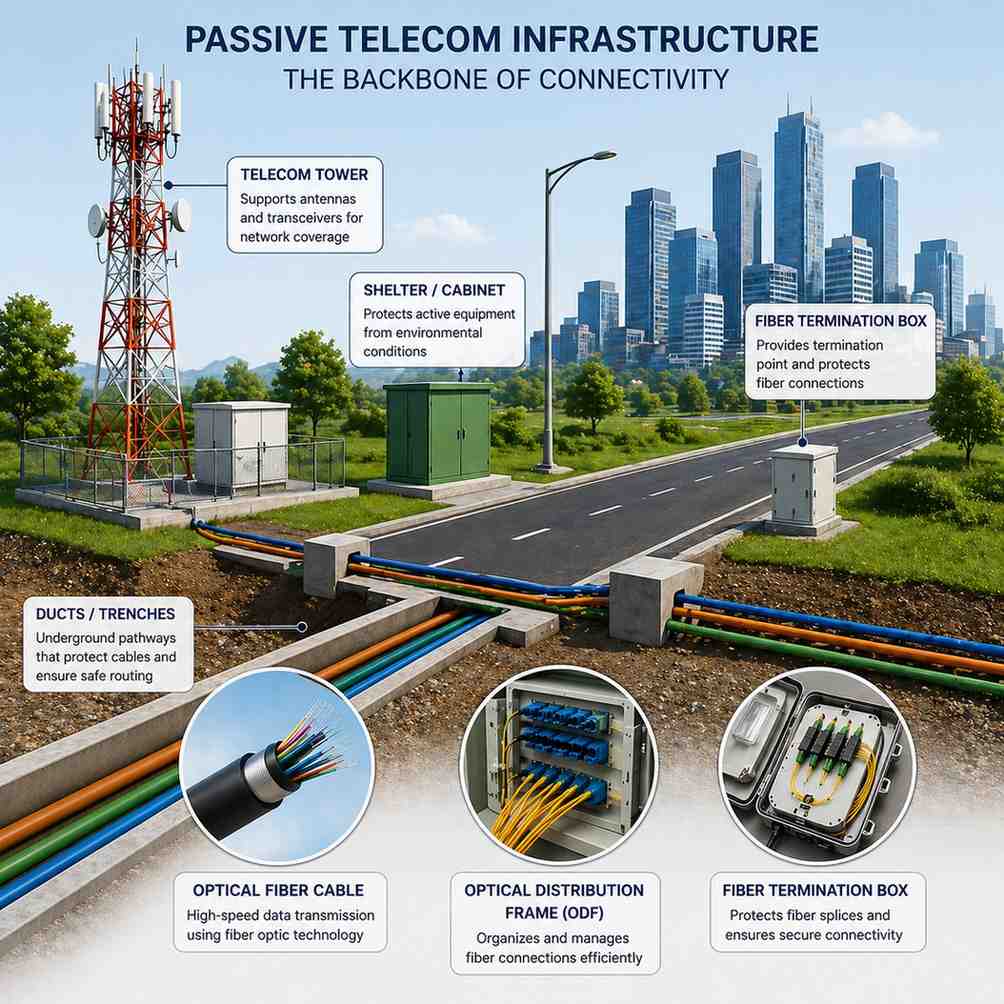
Key Components of Passive Telecom Infrastructure
1. Telecom Towers
These are the most visible parts of telecom infrastructure. Towers hold antennas and transmission equipment at height to ensure wide coverage.
Types include:
- Ground-based towers
- Rooftop towers
- Monopoles
2. Optical Fiber Cables
Optical fiber cables are used to transmit data at high speed using light signals. They are essential for broadband and high-speed internet.
Benefits:
- High bandwidth
- Low signal loss
- Long-distance transmission
3. Optical Fiber Terminal Boxes
These boxes are used to terminate and manage fiber cables efficiently. They protect fiber connections and ensure organized cable routing.
Learn more about our optical fiber solutions here
4. Ducts and Trenches
These are underground pathways that protect cables from environmental damage and ensure safe routing.
5. Shelters and Cabinets
These protect sensitive telecom equipment from weather conditions, dust, and physical damage.
How Passive Infrastructure Supports Modern Technologies
The basic telecommunication infrastructure supports the following modern communication technologies working as telecom infrastructure importance.
- 4G and 5G networks
- Broadband internet
- Smart cities
- IoT (Internet of Things)
The requirements for 5G technology include extensive fiber networks and multiple small cell towers which both require passive infrastructure for their operation.
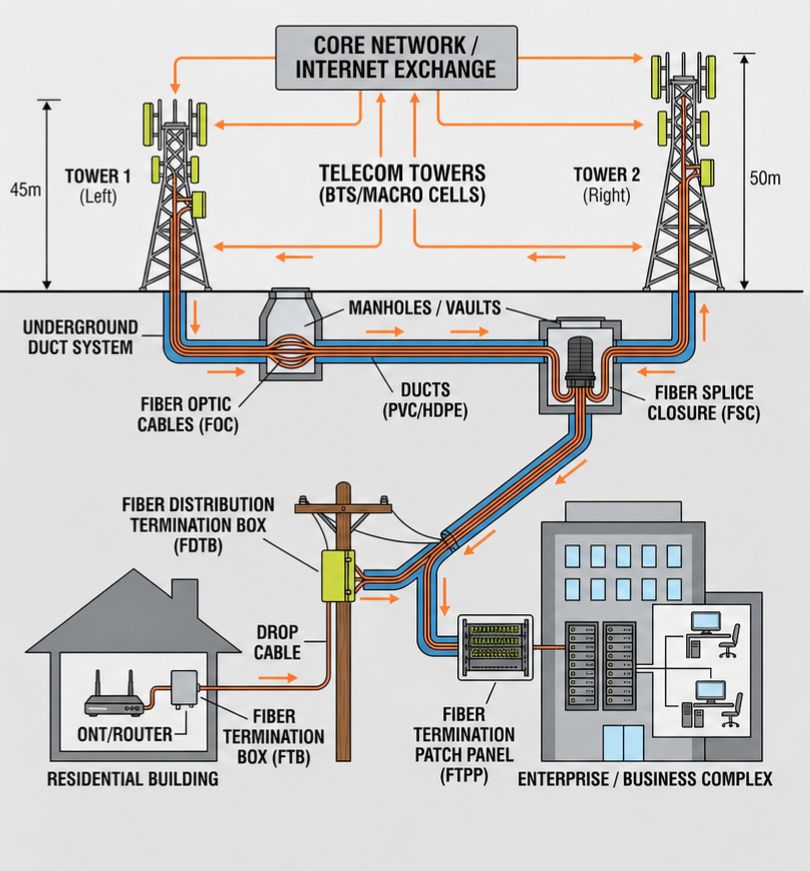
Basic structure of passive telecom infrastructure in a network
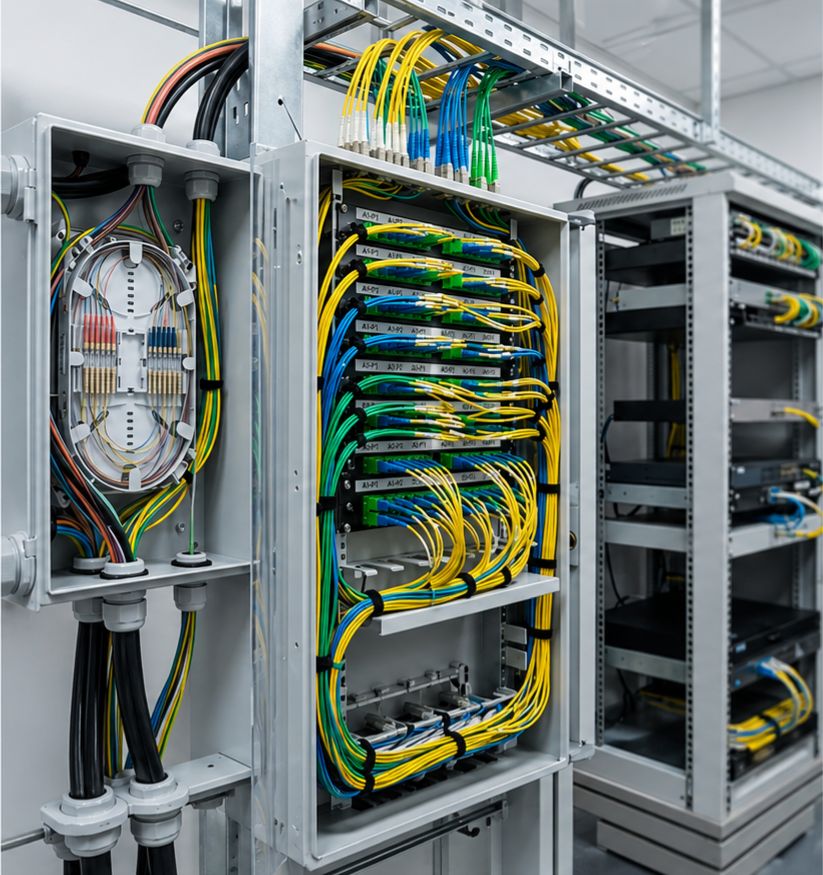
Optical fiber cable setup with termination and distribution system
Challenges in Passive Telecom Infrastructure
The situation presents critical challenges which must be resolved because it contains three main obstacles which need to be addressed. The project requires a significant initial financial commitment which makes it difficult to proceed. The project faces difficulties because it needs to acquire land for tower construction. The project requires maintenance work which needs to be done in extreme weather conditions. The project needs to obtain multiple regulatory permissions before it can proceed to the next phase.
The obstacles which appear in this situation become easier to handle when people apply their expertise together with their strategic planning abilities.
Future of Passive Telecom
Infrastructure
The demand for passive infrastructure is rapidly increasing due to:
- Growing internet usage
- Expansion of 5G networks
- Digital transformation across industries
Companies now concentrate their efforts on:
- Network fiberization
- Infrastructure sharing
- Designing sustainable intelligent systems
Why Choose Fusion Global?
Fusion Global delivers superior telecom passive infrastructure solutions which include three main products. The company offers three main products which include optical fiber terminal boxes and fiber cable solutions and telecom installation and service support. Our team uses cooperation with telecom experts and jointers and service providers to create dependable and effective solutions.
Conclusion
Passive telecom infrastructure may not be visible to end users, but it is the backbone of every communication network. From towers to fiber cables, these components ensure that data travels smoothly across the globe.
Understanding passive infrastructure is essential for anyone entering the telecom industry or looking to expand their knowledge.