
Introduction
Today, all digital networks depend on fast and dependable internet connections, which serve as their fundamental infrastructure. This will help you understandhow to choose the right optical fiber cable. Optical fiber cables establish essential links that support seamless data transfer between telecom networks and broadband services and enterprise networking systems.
The process of selecting an optical fiber cable requires careful evaluation because it presents multiple challenges. The selection of an inappropriate cable will result in performance problems and increased maintenance expenses together with decreased network performance because there are diverse cable types and different structures and specifications that need to be assessed.
The guide provides essential information that enables you to select the appropriate optical fiber cable according to your specific project needs.
1. Understand Your Project Requirements
Before choosing an optical fiber cable, you must first establish your complete requirements, which include the following factors:
- Transmission distance
- Installation type (indoor, outdoor, aerial, underground)
- Bandwidth requirements
- Environmental conditions
Example:
- Telecom backbone → high-capacity cables
- Office networks → short-distance solutions
Defining your project boundaries enables you to prevent expensive errors that might occur during later stages.
2. Types of Optical Fibre Cables
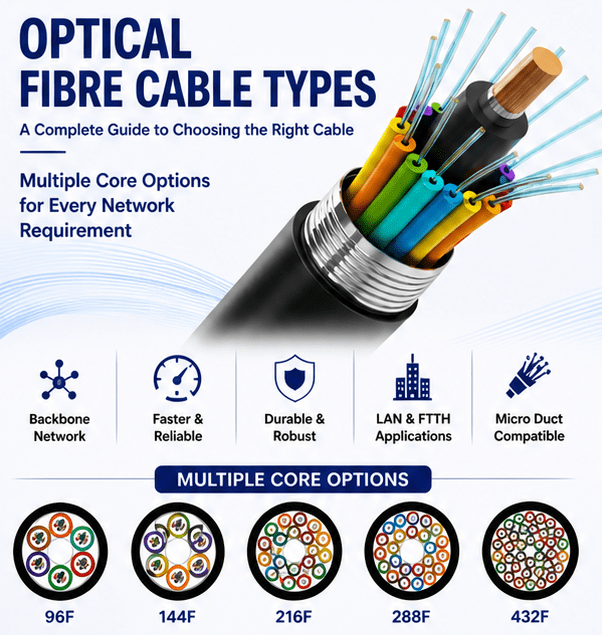
Optical fiber cable types come in different configurations depending on capacity and usage.
Common Core Types:
The core types of 96F, 144F, 216F, 288F, and 432F show increasing fiber counts that lead to increased data transmission capacity.
Single-Mode vs. Multi-Mode:
Single-Mode Fiber
The technology enables transmission over extended distances while it offers high bandwidth capacity for telecom networks.
Multi-Mode Fiber
The technology enables short-distance communication while it provides cost-effective solutions for local area networks and data centers.
👉 Tip: For long-distance and telecom projects, always go with single-mode fibre.
3. Cable Construction & Internal Structure
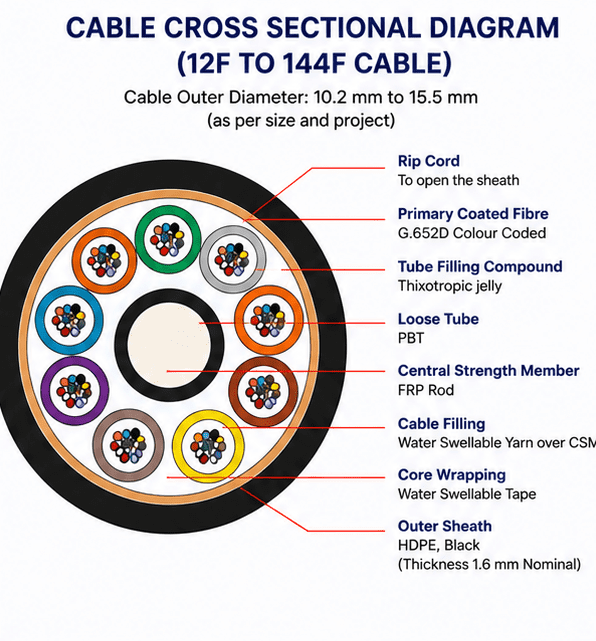
The internal structure of an optical fiber cable determines its ability to withstand damage while performing its functions.
Key Components:
- Optical Fibers – transmit data
- Loose Tubes – protect fibers
- Central Strength Member (FRP Rod) – adds strength
- Water Blocking Layers – prevent moisture damage
- Outer Sheath – protects from external conditions
Different constructions are used for different environments:
- Loose tube → outdoor use
- Tight buffered → indoor
- Armoured → harsh environments
4. Environmental Considerations
The location of installation will determine which cable becomes the optimal choice.
- Underground: moisture-resistant, high durability
- Aerial: lightweight and tension-resistant
- Industrial: heat and chemical-resistant
- Outdoor: UV-protected
The failure of cables will occur prematurely when environmental factors remain unaddressed.
5. Bandwidth & Future Scalability
Your network should not only meet current needs but also future demands.
Applications like:
- 5G networks
- Cloud computing
- IoT systems
Require high bandwidth and low latency.
👉 Always choose a cable that supports future expansion.
6. Installation & Compatibility
The total expense of a project decreases when its installation process becomes more efficient.
The following aspects should be evaluated:
- The ability to connect wires together without difficulty
- The system’s capacity to adapt to different situations
- The system’s ability to work with various types of connectors
- The system’s capacity to access additional components
The success of the project implementation depends on the establishment of proper planning methods.
7. Optical Fiber Cable Range & Applications
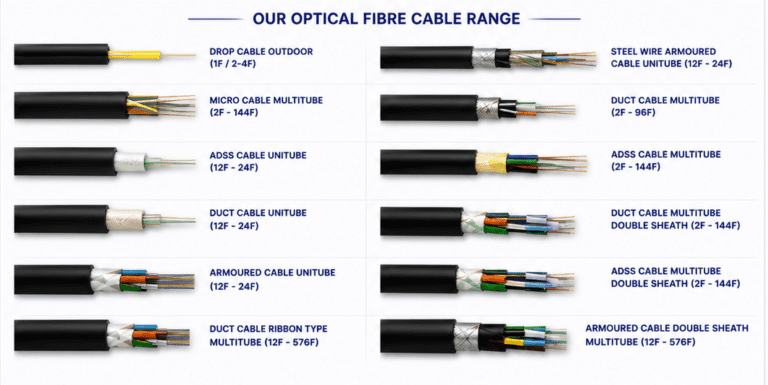
A wide range of optical fibre cables is available for different applications:
- Drop Cables → FTTH connections
- ADSS Cables → aerial installations
- Duct Cables → underground networks
- Armoured Cables → industrial and high-risk areas
- Ribbon & Multitube Cables → high-capacity networks
The selection of appropriate cable types leads to dependable performance which lasts throughout its entire service period.
Conclusion
The choice of optical fiber cable that you select will determine how your network functions, while its operational lifespan and ability to expand will be affected by this decision. The selection process requires you to first understand your project needs and the surrounding environmental factors and the specific technical requirements of your project.
Fusion Global provides telecom infrastructure solutions that include optical fiber cables that deliver high performance and reliability and extended value to customers.